
FLAMIN-GO
From pathobioLogy to synoviA on chip:
driving rheuMatoId arthritis to the precisioN medicine Goal
Funded by the European Union
This project has received funding from the European Union’s Horizon 2020 research and innovation programme under grant agreement No. 953121. Neither the European Commission nor any person acting on behalf of the Commission is responsible for how the following information is used. The views expressed in this publication are the sole responsibility of the authors and do not necessarily reflect the views of the European Commission.

FLAMIN-GO – G. A. n. 953121
Start date: 01.01.2021
End date: 30.06.2025
54 months
TYPE OF PROJECT
Next-generation joint-on-chip
Develop a personalized next-generation joint-on-chip, that will effectively be mimicking the complexity of RA joint, thus permitting in depth knowledge of this complex pathology.
RA joints
To replicate RA joints, thus allowing to test and allocate the best on-market drug for each individual patient in 1-2 months.
Reduce costs, time and animal testing
Enable screening of new drugs and/or drug repurposing reducing costs, time and animal testing.
Facilitate identification
Facilitate identification of new biomarkers or therapeutic targets
RESEARCH AREA
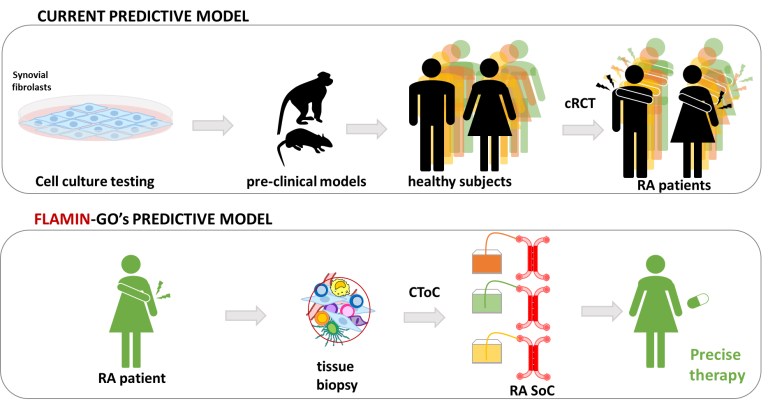
The EU funded research project FLAMIN-GO aims at developing the firs customized joint-on-chip. Such construct is able to recreate, starting from each patient’s biopsies, a three-dimensional in vitro model of the joint of the patient affected by rheumatoid arthritis (RA), for the personalized study of an effective therapy.
The platform proposed in FLAMIN-GO allow the independent identification and modulation of cellular and molecular factors responsible for disease onset and progression, allowing investigation of their contributions to disease development. The microfluidic cell compartments have been designed to host several tissue constructs (synovial, osteo-chondral and vascular with the addition of the cells of the immune system) in a 3D integrated fashion.
HOW WE ARE DOING IT
Research
Rheumatoid arthritis (RA) is an autoimmune inflammatory disorder, primarily characterized by synovial joint inflammation, affecting ~0.5 to 1% of the overall population. RA over time leads to permanent disability thus representing enormous public health problem. As of today, no definitive cure for RA exists, and therapies in use are aiming towards amelioration or remission of the symptoms. However, approximately 40% of RA patients fail to achieve even 20% improvement in disease activity, with significant disability remaining in about a third of patients, and major work-related and social costs for patients and society. In addition, 10-20% of patients do not respond to any current medication, pointing to considerable disease heterogeneity and the need for testing and developing new drugs. A further point related to RA heterogeneity, is that there are no biomarkers of treatment response to individual drugs. Thus, a number of unmet needs still persist particularly related to response/non-response to powerful but expensive drugs.
Know-how
The strategy of FLAMIN-GO project is based on the design and implementation of a micro-fluidic and multi-compartment platform which allows to recreate a three-dimensional culture of all the relevant joint tissues starting from the biopsies of the individual patients. The tissues that will be created are the synovium and the synovial fluid, which are the pathogenetic target tissues, the immune system, which supports the disease, and cartilage and bone which are the terminal tissues which, once damaged, lead to permanent disability. RA is an autoimmune disease; hence the innovative and exclusive element of this device is the possibility of introducing the cells of the immune system responsible for the damage. The integration with a lab-on-chip and several sensors will allow to monitor continuously culturing conditions and response to drugs.
FLAMIN-GO’s VISION is to provide an organ-on-chip solution to open up a new avenue towards personalized care in RA.
RELATED PUBLICATIONS
2023
Worse Disease Prognosis Is Associated to an Increase of Platelet-Derived Extracellular Vesicles in Hospitalized SARS-CoV-2 Patients
Raineri D, Venegoni C, Calella MG, Vaschetto R, Scotti L, Canciani E, Manfredi M, Gavelli F, Castello L, Chiocchetti A, Cappellano G.
Dis Markers. 2022 Jul 7;2022:8074655. doi: doi.org/10.1155/2022/8074655. eCollection 2022.
Platelet-derived extracellular vesicles (PLT-EVs) were found increased in our previous study on COVID-19 patients, proposing them as a potential biomarker for the infection. This research investigates the predictive value of PLT-EV levels at hospital admission and within the first week of hospitalization. We confirmed in the third-wave of COVID-19 that PLT-EV are a biomarkers of disease. Interestingly, increased PLT-EV levels were found in hospitalized patients during the first week with unfavorable outcomes, by suggesting a correlation between rising PLT-EV levels in the first week after admission and a more severe disease progression.
Chitosan and Pectin Hydrogels for Tissue Engineering and In Vitro Modeling
Morello G, De Iaco G, Gigli G, Polini A, Gervaso F.
Gels. 2023 Feb 4;9(2):132. doi: doi.org/10.3390/gels9020132.
Hydrogels, as biomaterials, serve as supportive scaffolds for cell organization in 3D systems, recreating physiological and pathological cellular microenvironments. They are crucial for tissue engineering and 3D in vitro models, mimicking the extracellular matrix of specific organs. Polysaccharide-based hydrogels, especially those using chitosan and pectin, demonstrate excellent biocompatibility and beneficial interaction with cellular components. Despite the growing interest in such hydrogels, there is a lack of focus on the combined use of chitosan and pectin. This review explores the biomedical applications of hydrogels incorporating both polysaccharides in tissue engineering and 3D in vitro modeling.
Fluorescent nano- and microparticles for sensing cellular microenvironment: past, present and future applications
Giuliana Grasso, Francesco Colella, Stefania Forciniti, Valentina Onesto, Helena Iuele, Anna Chiara Siciliano, Federica Carnevali, Anil Chandra, Giuseppe Gigliab and Loretta L. del Mercato.
Nanoscale Adv., 2023, 5, 4311 , DOI: 10.1039/d3na00218g
The tumor microenvironment (TME) holds critical markers for early cancer detection and treatment. Ratiometric fluorescence sensors play a key role in monitoring TME traits like acidity, oxygen, and ions. This review explores their latest advancements, design, and applications, offering insights into TME dynamics for improved cancer research and diagnosis.
Image-based cell sorting using focused travelling surface acoustic waves
Nawaz, Ahmad Ahsan and Soteriou, Despina and Xu, Catherine K. and Goswami, Ruchi and Herbig, Maik and Guck, Jochen and Girardo, Salvatore.
Lab Chip, 2023, 23, 2, 372-387,
doi: https://doi.org/10.1039/D2LC00636G
The combination of real-time deformability cytometry (RT-DC) with a focused traveling surface acoustic wave (FTSAW)-based actuator provides a user-friendly, label-free, reliable, and high-throughput microfluidic device for continuous image-based cell sorting with high purity and sensitivity. In our paper recently published on Lab on a Chip Journal, we demonstrated the sorting of multiple cell types of different sizes and mechanical properties, corresponding to a wide range of mammalian cells. Our technique opens the prospect of sorting cells based on their morpho-rheological phenotype that in combination with downstream analysis can provide new insights into the correlation between cell physical properties and biological functions.
Ph-Sensing Hydrogels for Non-Invasive Metabolism Monitoring in Tumor Spheroids
Rizzo, Riccardo and Onesto, Valentina and Morello, Giulia and Iuele, Helena and Scalera, Francesca and Gigli, Giuseppe and Polini, Alessandro and Gervaso, Francesca and del Mercato, Loretta L.
SSRN, doi: http://dx.doi.org/10.2139/ssrn.4364505
Acidification of extracellular pH is a well-known feature of solid tumors, correlated to cancer initiation, progression, and resistance to therapies. Monitoring local pH variations, non-invasively, during cancer growth and in response to drug treatment becomes extremely important for understanding cancer mechanisms. Here, we describe a simple and reliable pH-sensing system based on a thermoresponsive hydrogel embedding optical pH-sensors that enable non-invasive and accurate metabolism monitoring in colorectal cancer (CRC) spheroids. These findings will be essential for the study of solid tumors in vitro and the development of personalized medicine approaches.
2022
- Bucciarelli A, Paolelli X, De Vitis E, Selicato N, Gervaso F, Gigli G, Moroni L, Polini A.
VAT photopolymerization 3D printing optimization of high aspect ratio structures for additive manufacturing of chips towards biomedical applications,
Additive Manufacturing, Volume 60, Part A, 2022, doi: doi.org/10.1016/j.addma.2022.103200 - Neto E, Monteiro AC, Leite Pereira C, Simões M, Conde JP, Chu V, Sarmento B, Lamghari M.
Micropathological Chip Modeling the Neurovascular Unit Response to Inflammatory Bone Condition.
Adv Healthc Mater. 2022 Feb 14:e2102305. doi: 10.1002/adhm.202102305 - Polini A, Moroni L.
The convergence of high-tech emerging technologies into the next stage of organ-on-a-chips.
Biomaterials and Biosystems Volume 1, March 2021, 100012. doi: 10.1016/j.bbiosy.2021.100012 - Mazzucca CB, Scotti L, Cappellano G, Barone-Adesi F, Chiocchetti A.
Nutrition and Rheumatoid Arthritis Onset: A Prospective Analysis Using the UK Biobank.
Nutrients. 2022; 14(8):1554. doi: 10.3390/nu14081554 - Raineri D, Cappellano G, Vilardo B, Maione F, Clemente N, Canciani E, Boggio E, Gigliotti CL, Monge C, Dianzani C, Boldorini R, Dianzani U, Chiocchetti A.
Inducible T-Cell Costimulator Ligand Plays a Dual Role in Melanoma Metastasis upon Binding to Osteopontin or Inducible T-Cell Costimulator.
Biomedicines. 2022; 10(1):51. doi: 10.3390/biomedicines10010051 - Neto, E., Monteiro, A. C., Leite Pereira, C., Simões, M., Conde, J. P., Chu, V., … & Lamghari, M.
Micropathological Chip Modeling the Neurovascular Unit Response to Inflammatory Bone Condition.
Advanced Healthcare Materials, 2022, 2102305. doi: 10.1002/adhm.202102305
2021
- Mazzucca CB, Raineri D, Cappellano G, Chiocchetti A.
How to Tackle the Relationship between Autoimmune Diseases and Diet: Well Begun Is Half-Done.
Nutrients. 2021; 13(11):3956. doi: 10.3390/nu13113956 - Cappellano G, Abreu H, Casale C, Dianzani U, Chiocchetti A.
Nano-Microparticle Platforms in Developing Next-Generation Vaccines.
Vaccines. 2021; 9(6):606. doi: 10.3390/vaccines9060606 - Morello G, Polini A, Scalera F, Rizzo R, Gigli G, Gervaso F.
Preparation and Characterization of Salt-Mediated Injectable Thermosensitive Chitosan/Pectin Hydrogels for Cell Embedding and Culturing.
Polymers. 2021; 13(16):2674. doi: 10.3390/polym13162674 - Stanzione, A., Polini, A., La Pesa, V., Quattrini, A., Romano, A., Gigli, G., Gervaso, F.
Thermosensitive chitosan-based hydrogels supporting motor neuron-like NSC-34 cell differentiation.
Biomaterials Science, 9(22), 2021, 7492-7503. doi: 10.1039/D1BM01129D - Polini, A., & Moroni, L.
The convergence of high-tech emerging technologies into the next stage of organ-on-a-chips.
Biomaterials and Biosystems, 1, 100012. doi: 10.1016/j.bbiosy.2021.100012 - De Vitis, E., La Pesa, V., Gervaso, F., Romano, A., Quattrini, A., Gigli, G., Polini, A.
A microfabricated multi-compartment device for neuron and Schwann cell differentiation.
Scientific reports, 2021, 11(1), 1-12. doi: 10.1038/s41598-021-86300-4
OUR PARTNERS
- Università degli Studi del Piemonte Orientale Amedeo Avogadro (UPO) – Novara, ITALY
- Istituto Nacional De Engenharia Biomedica (INEB) – Porto, PORTUGAL
- Consiglio Nazionale delle Ricerche (CNR) – Lecce, ITALY
- Queen Mary University of London (QMUL) – London, UK
- Association on Research that Cures, nonprofit socially beneficial to society association (ARCA) – Novara, ITALY
- Rigas Tehniska Universitate (RTU) – Riga, LATVIA
- Engisoft Turkey Muhendislik Yazilim Ticaret Limited Sirketi (ES) – Istanbul, TURKEY
- Fluidigm France Sarl (FLUIDIGM) – Les Ulis, FRANCE
- Ao-Forschungsinstitut Davos (ARI) – Davos, SWITZERLAND
- Trustech srl – Turin, ITALY
- Max-Planck-Gesellschaft Zur Forderung Der Wissenschaften EV – München, GERMANY
- Znanost Na Cesti, Zavod Za Promocijo Znanosti, Ljubljana (soS) – Ljubljana, SLOVENIA
- Regenhu SA (reH) – Villaz-St-Pierre, SWITZERLAND
- EU Core Consulting srl (EUCORE) – Rome, ITALY

FLAMIN-GO
From pathobioLogy to synoviA on chip: driving rheuMatoId arthritis to the precisioN medicine Goal
Funded by the European Union
This project has received funding from the European Union’s Horizon 2020 research and innovation programme under grant agreement No. 953121. Neither the European Commission nor any person acting on behalf of the Commission is responsible for how the following information is used. The views expressed in this publication are the sole responsibility of the authors and do not necessarily reflect the views of the European Commission.
FLAMIN-GO – G. A. n. 953121
Start date: 01.01.2021
End date: 30.06.2025
54 months
TYPE OF PROJECT
Next-generation joint-on-chip
Develop a personalized next-generation joint-on-chip, that will effectively be mimicking the complexity of RA joint, thus permitting in depth knowledge of this complex pathology.
RA joints
To replicate RA joints, thus allowing to test and allocate the best on-market drug for each individual patient in 1-2 months.
Reduce costs, time and animal testing
Enable screening of new drugs and/or drug repurposing reducing costs, time and animal testing.
Facilitate identification
Facilitate identification of new biomarkers or therapeutic targets
RESEARCH AREA
The EU funded research project FLAMIN-GO aims at developing the firs customized joint-on-chip. Such construct is able to recreate, starting from each patient’s biopsies, a three-dimensional in vitro model of the joint of the patient affected by rheumatoid arthritis (RA), for the personalized study of an effective therapy.
The platform proposed in FLAMIN-GO allow the independent identification and modulation of cellular and molecular factors responsible for disease onset and progression, allowing investigation of their contributions to disease development. The microfluidic cell compartments have been designed to host several tissue constructs (synovial, osteo-chondral and vascular with the addition of the cells of the immune system) in a 3D integrated fashion.
HOW WE ARE DOING IT
Research
Rheumatoid arthritis (RA) is an autoimmune inflammatory disorder, primarily characterized by synovial joint inflammation, affecting ~0.5 to 1% of the overall population. RA over time leads to permanent disability thus representing enormous public health problem. As of today, no definitive cure for RA exists, and therapies in use are aiming towards amelioration or remission of the symptoms. However, approximately 40% of RA patients fail to achieve even 20% improvement in disease activity, with significant disability remaining in about a third of patients, and major work-related and social costs for patients and society. In addition, 10-20% of patients do not respond to any current medication, pointing to considerable disease heterogeneity and the need for testing and developing new drugs. A further point related to RA heterogeneity, is that there are no biomarkers of treatment response to individual drugs. Thus, a number of unmet needs still persist particularly related to response/non-response to powerful but expensive drugs.
Know-how
The strategy of FLAMIN-GO project is based on the design and implementation of a micro-fluidic and multi-compartment platform which allows to recreate a three-dimensional culture of all the relevant joint tissues starting from the biopsies of the individual patients. The tissues that will be created are the synovium and the synovial fluid, which are the pathogenetic target tissues, the immune system, which supports the disease, and cartilage and bone which are the terminal tissues which, once damaged, lead to permanent disability. RA is an autoimmune disease; hence the innovative and exclusive element of this device is the possibility of introducing the cells of the immune system responsible for the damage. The integration with a lab-on-chip and several sensors will allow to monitor continuously culturing conditions and response to drugs.
FLAMIN-GO’s VISION is to provide an organ-on-chip solution to open up a new avenue towards personalized care in RA.
RELATED PUBLICATIONS
2023
Worse Disease Prognosis Is Associated to an Increase of Platelet-Derived Extracellular Vesicles in Hospitalized SARS-CoV-2 Patients
Raineri D, Venegoni C, Calella MG, Vaschetto R, Scotti L, Canciani E, Manfredi M, Gavelli F, Castello L, Chiocchetti A, Cappellano G.
Dis Markers. 2022 Jul 7;2022:8074655. doi: doi.org/10.1155/2022/8074655. eCollection 2022.
Platelet-derived extracellular vesicles (PLT-EVs) were found increased in our previous study on COVID-19 patients, proposing them as a potential biomarker for the infection. This research investigates the predictive value of PLT-EV levels at hospital admission and within the first week of hospitalization. We confirmed in the third-wave of COVID-19 that PLT-EV are a biomarkers of disease. Interestingly, increased PLT-EV levels were found in hospitalized patients during the first week with unfavorable outcomes, by suggesting a correlation between rising PLT-EV levels in the first week after admission and a more severe disease progression.
Chitosan and Pectin Hydrogels for Tissue Engineering and In Vitro Modeling
Morello G, De Iaco G, Gigli G, Polini A, Gervaso F.
Gels. 2023 Feb 4;9(2):132. doi: doi.org/10.3390/gels9020132.
Hydrogels, as biomaterials, serve as supportive scaffolds for cell organization in 3D systems, recreating physiological and pathological cellular microenvironments. They are crucial for tissue engineering and 3D in vitro models, mimicking the extracellular matrix of specific organs. Polysaccharide-based hydrogels, especially those using chitosan and pectin, demonstrate excellent biocompatibility and beneficial interaction with cellular components. Despite the growing interest in such hydrogels, there is a lack of focus on the combined use of chitosan and pectin. This review explores the biomedical applications of hydrogels incorporating both polysaccharides in tissue engineering and 3D in vitro modeling.
Fluorescent nano- and microparticles for sensing cellular microenvironment: past, present and future applications
Giuliana Grasso, Francesco Colella, Stefania Forciniti, Valentina Onesto, Helena Iuele, Anna Chiara Siciliano, Federica Carnevali, Anil Chandra, Giuseppe Gigliab and Loretta L. del Mercato.
Nanoscale Adv., 2023, 5, 4311 , DOI: 10.1039/d3na00218g
The tumor microenvironment (TME) holds critical markers for early cancer detection and treatment. Ratiometric fluorescence sensors play a key role in monitoring TME traits like acidity, oxygen, and ions. This review explores their latest advancements, design, and applications, offering insights into TME dynamics for improved cancer research and diagnosis.
Image-based cell sorting using focused travelling surface acoustic waves
Nawaz, Ahmad Ahsan and Soteriou, Despina and Xu, Catherine K. and Goswami, Ruchi and Herbig, Maik and Guck, Jochen and Girardo, Salvatore.
Lab Chip, 2023, 23, 2, 372-387,
doi: https://doi.org/10.1039/D2LC00636G
The combination of real-time deformability cytometry (RT-DC) with a focused traveling surface acoustic wave (FTSAW)-based actuator provides a user-friendly, label-free, reliable, and high-throughput microfluidic device for continuous image-based cell sorting with high purity and sensitivity. In our paper recently published on Lab on a Chip Journal, we demonstrated the sorting of multiple cell types of different sizes and mechanical properties, corresponding to a wide range of mammalian cells. Our technique opens the prospect of sorting cells based on their morpho-rheological phenotype that in combination with downstream analysis can provide new insights into the correlation between cell physical properties and biological functions.
Ph-Sensing Hydrogels for Non-Invasive Metabolism Monitoring in Tumor Spheroids
Rizzo, Riccardo and Onesto, Valentina and Morello, Giulia and Iuele, Helena and Scalera, Francesca and Gigli, Giuseppe and Polini, Alessandro and Gervaso, Francesca and del Mercato, Loretta L.
SSRN, doi: http://dx.doi.org/10.2139/ssrn.4364505
Acidification of extracellular pH is a well-known feature of solid tumors, correlated to cancer initiation, progression, and resistance to therapies. Monitoring local pH variations, non-invasively, during cancer growth and in response to drug treatment becomes extremely important for understanding cancer mechanisms. Here, we describe a simple and reliable pH-sensing system based on a thermoresponsive hydrogel embedding optical pH-sensors that enable non-invasive and accurate metabolism monitoring in colorectal cancer (CRC) spheroids. These findings will be essential for the study of solid tumors in vitro and the development of personalized medicine approaches.
2022
- Bucciarelli A, Paolelli X, De Vitis E, Selicato N, Gervaso F, Gigli G, Moroni L, Polini A.
VAT photopolymerization 3D printing optimization of high aspect ratio structures for additive manufacturing of chips towards biomedical applications,
Additive Manufacturing, Volume 60, Part A, 2022, doi: doi.org/10.1016/j.addma.2022.103200 - Neto E, Monteiro AC, Leite Pereira C, Simões M, Conde JP, Chu V, Sarmento B, Lamghari M.
Micropathological Chip Modeling the Neurovascular Unit Response to Inflammatory Bone Condition.
Adv Healthc Mater. 2022 Feb 14:e2102305. doi: 10.1002/adhm.202102305 - Polini A, Moroni L.
The convergence of high-tech emerging technologies into the next stage of organ-on-a-chips.
Biomaterials and Biosystems Volume 1, March 2021, 100012. doi: 10.1016/j.bbiosy.2021.100012 - Mazzucca CB, Scotti L, Cappellano G, Barone-Adesi F, Chiocchetti A.
Nutrition and Rheumatoid Arthritis Onset: A Prospective Analysis Using the UK Biobank.
Nutrients. 2022; 14(8):1554. doi: 10.3390/nu14081554 - Raineri D, Cappellano G, Vilardo B, Maione F, Clemente N, Canciani E, Boggio E, Gigliotti CL, Monge C, Dianzani C, Boldorini R, Dianzani U, Chiocchetti A.
Inducible T-Cell Costimulator Ligand Plays a Dual Role in Melanoma Metastasis upon Binding to Osteopontin or Inducible T-Cell Costimulator.
Biomedicines. 2022; 10(1):51. doi: 10.3390/biomedicines10010051 - Neto, E., Monteiro, A. C., Leite Pereira, C., Simões, M., Conde, J. P., Chu, V., … & Lamghari, M.
Micropathological Chip Modeling the Neurovascular Unit Response to Inflammatory Bone Condition.
Advanced Healthcare Materials, 2022, 2102305. doi: 10.1002/adhm.202102305
2021
- Mazzucca CB, Raineri D, Cappellano G, Chiocchetti A.
How to Tackle the Relationship between Autoimmune Diseases and Diet: Well Begun Is Half-Done.
Nutrients. 2021; 13(11):3956. doi: 10.3390/nu13113956 - Cappellano G, Abreu H, Casale C, Dianzani U, Chiocchetti A.
Nano-Microparticle Platforms in Developing Next-Generation Vaccines.
Vaccines. 2021; 9(6):606. doi: 10.3390/vaccines9060606 - Morello G, Polini A, Scalera F, Rizzo R, Gigli G, Gervaso F.
Preparation and Characterization of Salt-Mediated Injectable Thermosensitive Chitosan/Pectin Hydrogels for Cell Embedding and Culturing.
Polymers. 2021; 13(16):2674. doi: 10.3390/polym13162674 - Stanzione, A., Polini, A., La Pesa, V., Quattrini, A., Romano, A., Gigli, G., Gervaso, F.
Thermosensitive chitosan-based hydrogels supporting motor neuron-like NSC-34 cell differentiation.
Biomaterials Science, 9(22), 2021, 7492-7503. doi: 10.1039/D1BM01129D - Polini, A., & Moroni, L.
The convergence of high-tech emerging technologies into the next stage of organ-on-a-chips.
Biomaterials and Biosystems, 1, 100012. doi: 10.1016/j.bbiosy.2021.100012 - De Vitis, E., La Pesa, V., Gervaso, F., Romano, A., Quattrini, A., Gigli, G., Polini, A.
A microfabricated multi-compartment device for neuron and Schwann cell differentiation.
Scientific reports, 2021, 11(1), 1-12. doi: 10.1038/s41598-021-86300-4
OUR PARTNERS
- Università degli Studi del Piemonte Orientale Amedeo Avogadro (UPO) – Novara, ITALY
- Istituto Nacional De Engenharia Biomedica (INEB) – Porto, PORTUGAL
- Consiglio Nazionale delle Ricerche (CNR) – Lecce, ITALY
- Queen Mary University of London (QMUL) – London, UK
- Association on Research that Cures, nonprofit socially beneficial to society association (ARCA) – Novara, ITALY
- Rigas Tehniska Universitate (RTU) – Riga, LATVIA
- Engisoft Turkey Muhendislik Yazilim Ticaret Limited Sirketi (ES) – Istanbul, TURKEY
- Fluidigm France Sarl (FLUIDIGM) – Les Ulis, FRANCE
- Ao-Forschungsinstitut Davos (ARI) – Davos, SWITZERLAND
- Trustech srl – Turin, ITALY
- Max-Planck-Gesellschaft Zur Forderung Der Wissenschaften EV – München, GERMANY
- Znanost Na Cesti, Zavod Za Promocijo Znanosti, Ljubljana (soS) – Ljubljana, SLOVENIA
- Regenhu SA (reH) – Villaz-St-Pierre, SWITZERLAND
- EU Core Consulting srl (EUCORE) – Rome, ITALY