
FORCE REPAIR
smart and multiFunctional 3D printable prO-Regenerative biologiCal matrix modulating mEchanotRansduction as advancEd theraPy to treAt skIn chRonic wounds
Funded by the European Union
This project has received funding from the European Union’s Horizon 2020 research and innovation programme under grant agreement No. 101092243. Neither the European Commission nor any person acting on behalf of the Commission is responsible for how the following information is used. The views expressed in this publication are the sole responsibility of the authors and do not necessarily reflect the views of the European Commission.

FORCE REPAIR – G. A. n. 101092243
Start date: 01.01.2023
End date: 31.12.2026
48 months
TYPE OF PROJECT
Advance chronic wound management
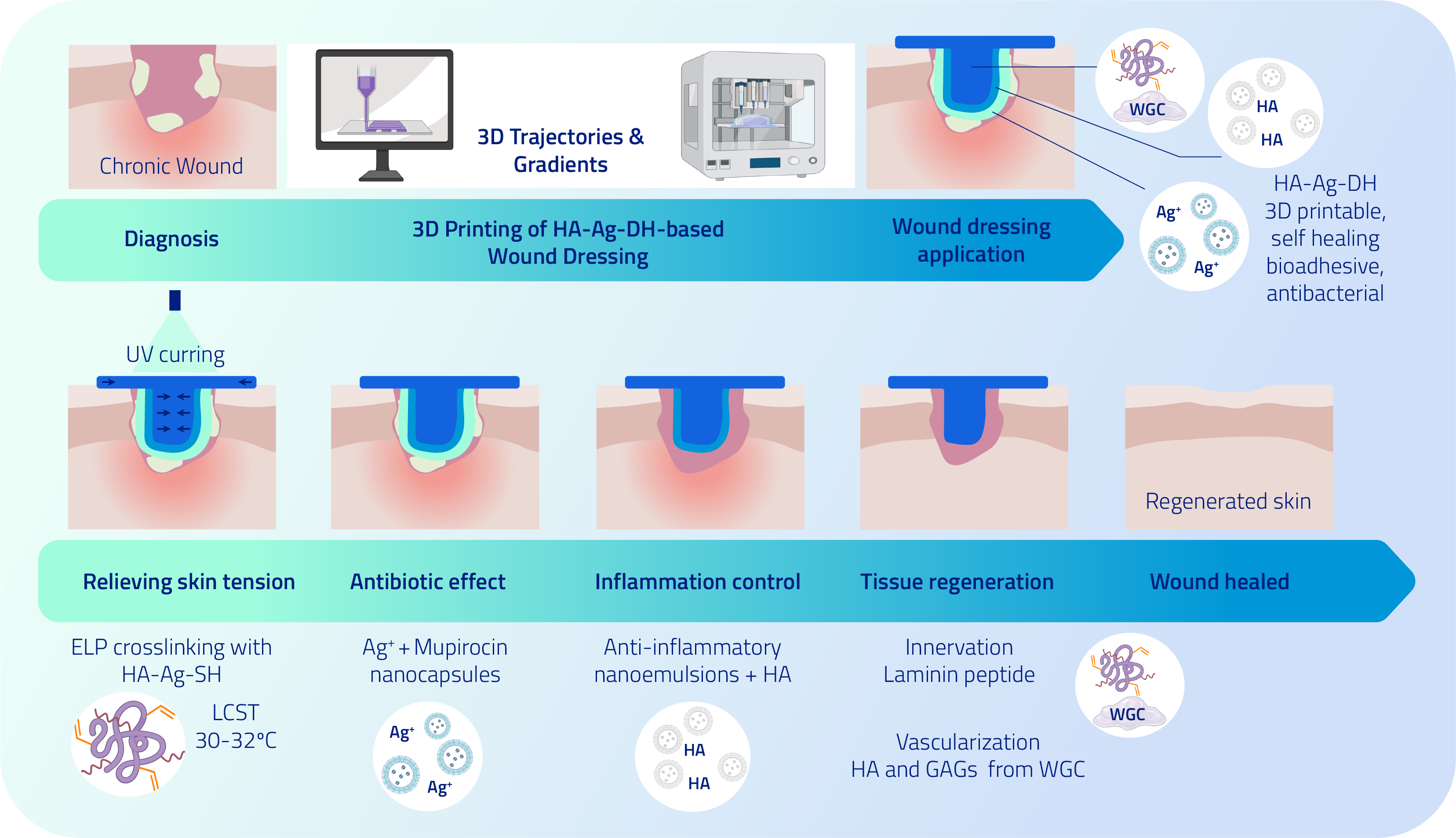
Sets out to advance chronic wound management by developing a smart, multifunctional, and cost-effective 3D-printed wound dressing to help control bacterial infection and inflammation.
Improve patient life and reduce costs
- improve patients’ overall quality of life.
- reduce health care costs.
Global sustainable development goals
- contribute to the global sustainable development goals.
- minimise material waste and energy consumption.
- provide solutions for a clean pollutant free environment.
RESEARCH AREA
FORCE REPAIR aims to advance chronic wound management by developing a smart, multifunctional, and cost-effective 3D-printed wound dressing that effectively combats bacterial infections and inflammation, promotes healing, and relieves skin tension.
This innovative dressing uses cutting-edge technologies such as nanocarriers, antibiotics, and anti-inflammatory drugs, along with pro-regenerative active ingredients. It will offer a sustained regenerative effect for a minimum of 15 days, which will greatly reduce the frequency at which nurses need to change the dressing. This will ultimately lead to a fully healed wound with a low likelihood of re-opening.
HOW WE ARE DOING IT
Why we are doing it
Due to population lifestyle changes, i.e., obesity, diabetes and an ageing population, chronic wounds (CW) which fail to follow the typical healing process are a major medical and socioeconomic challenge. These wounds are multifaceted, with bacterial infection from biofilm-forming strains, uncontrolled inflammation hindering skin self-regeneration, and wound exudate formation that blocks oxygenation and impedes wound closure. Current treatments involving frequent debridement and basic wound dressings administered by a nurse are insufficient. FORCE REPAIR aims to develop multifunctional biomaterials to address and overcome these multiple challenges, responding to unmet clinical needs by improving biocompatibility, bio specificity, longevity, bioactivity, and biodegradability while considering physiological and biomechanical constraints and implications.
Know-how
The FORCE REPAIR concept is based on a unique 3D printable hyaluronic acid-based self-healing hydrogel (HA-Ag-DH) with antibacterial and bioadhesive properties, which will maintain the moisture of the wound over a long period of time. The printable biomaterial will allow the placement of each component in a strategic location to fight infection and reduce inflammation to recreate the environment of healthy tissue.
THE ROLE OF UPO
In the EU research project FORCE REPAIR UPO is leading the the studies of evaluation of immunological response by implementing next generation cytofluorimetric analysis and imaging mass cytometry. UPO is directly involved in defining the antibacterial properties and biofilm interaction of bio-ink and combined products.
The antibacterial bio-ink and HA-DH will be studied against planktonic and biofilm models of sensitive and/or multi drug resistant (MRSA) strains. PBMC from healthy donors will be co-cultured with bacteria (with/without the bio-ink) in order to evaluate the immunological response to the 3D-printed scaffold and its component. Proliferation and phenotype of cultured cells will be assessed by flow cytometry.
UPO will custom-design and validate specific panel for imaging mass cytometry analysis (Hyperion) on excised 3D printed scaffold embedded tissue. The immune response provoked by the 3D printed dressing implanted subcutaneously will be evaluated on splenocytes by flow cytometry/real-time PCR.
OUR PARTNERS
- Fundacion Cidetec (CID) – San Sebastian, SPAIN
- Università degli Studi del Piemonte Orientale Amedeo Avogadro (UPO) – Novara, ITALY
- Histocell SL (HCELL) – Erio Bizkaia, SPAIN
- Eurice European Research and Project Office GMBH (EURICE) – St. Ingbert, GERMANY
- Asphalion SL (ASPH) – Barcelona, SPAIN
- Akribes Biomedical GMBH (AKR) – Wien, AUSTRIA
- Fundacion Idonial (IDO) – Gijon, SPAIN
- Betthera S.R.O. – Hradec Kralove, CZECHIA
- Fundacion Centro De Tecnologias De Interaccion Visual Y Comunicaciones Vicomtech (VICOM) –
- Donostia San Sebastian, SPAIN
- Cap Partner Aps, Ewma Secretariat DFSG Secretariat (EWMA) – Frederiksberg, DENMARK
- Università degli Studi di Pavia (UNIPV) – Pavia, ITALY
- Centre National de la Recherche Scientifique CNRS – Paris, FRANCE
- Joanneum Research Forschungsgesellschaft MBH (JOAN) – Graz, AUSTRIA
- Institut National De La Sante Et De La Recherche Medicale (INSERM) – Paris, FRANCE

FORCE REPAIR
smart and multiFunctional 3D printable prO-Regenerative biologiCal matrix modulating mEchanotRansduction as advancEd theraPy to treAt skIn chRonic wounds
Funded by the European Union
This project has received funding from the European Union’s Horizon 2020 research and innovation programme under grant agreement No. 101092243. Neither the European Commission nor any person acting on behalf of the Commission is responsible for how the following information is used. The views expressed in this publication are the sole responsibility of the authors and do not necessarily reflect the views of the European Commission.
FORCE REPAIR – G. A. n. 101092243
Start date: 01.01.2023
End date: 31.12.2026
48 months
TYPE OF PROJECT
Advance chronic wound management
Sets out to advance chronic wound management by developing a smart, multifunctional, and cost-effective 3D-printed wound dressing to help control bacterial infection and inflammation.
Improve patient life and reduce costs
- improve patients’ overall quality of life.
- reduce health care costs.
Global sustainable development goals
- contribute to the global sustainable development goals.
- minimise material waste and energy consumption.
- provide solutions for a clean pollutant free environment.
RESEARCH AREA
FORCE REPAIR aims to advance chronic wound management by developing a smart, multifunctional, and cost-effective 3D-printed wound dressing that effectively combats bacterial infections and inflammation, promotes healing, and relieves skin tension.
This innovative dressing uses cutting-edge technologies such as nanocarriers, antibiotics, and anti-inflammatory drugs, along with pro-regenerative active ingredients. It will offer a sustained regenerative effect for a minimum of 15 days, which will greatly reduce the frequency at which nurses need to change the dressing. This will ultimately lead to a fully healed wound with a low likelihood of re-opening.
HOW WE ARE DOING IT
Why we are doing it
Due to population lifestyle changes, i.e., obesity, diabetes and an ageing population, chronic wounds (CW) which fail to follow the typical healing process are a major medical and socioeconomic challenge. These wounds are multifaceted, with bacterial infection from biofilm-forming strains, uncontrolled inflammation hindering skin self-regeneration, and wound exudate formation that blocks oxygenation and impedes wound closure. Current treatments involving frequent debridement and basic wound dressings administered by a nurse are insufficient. FORCE REPAIR aims to develop multifunctional biomaterials to address and overcome these multiple challenges, responding to unmet clinical needs by improving biocompatibility, bio specificity, longevity, bioactivity, and biodegradability while considering physiological and biomechanical constraints and implications.
Know-how
The FORCE REPAIR concept is based on a unique 3D printable hyaluronic acid-based self-healing hydrogel (HA-Ag-DH) with antibacterial and bioadhesive properties, which will maintain the moisture of the wound over a long period of time. The printable biomaterial will allow the placement of each component in a strategic location to fight infection and reduce inflammation to recreate the environment of healthy tissue.
THE ROLE OF UPO
In the EU research project FORCE REPAIR UPO is leading the the studies of evaluation of immunological response by implementing next generation cytofluorimetric analysis and imaging mass cytometry. UPO is directly involved in defining the antibacterial properties and biofilm interaction of bio-ink and combined products.
The antibacterial bio-ink and HA-DH will be studied against planktonic and biofilm models of sensitive and/or multi drug resistant (MRSA) strains. PBMC from healthy donors will be co-cultured with bacteria (with/without the bio-ink) in order to evaluate the immunological response to the 3D-printed scaffold and its component. Proliferation and phenotype of cultured cells will be assessed by flow cytometry.
UPO will custom-design and validate specific panel for imaging mass cytometry analysis (Hyperion) on excised 3D printed scaffold embedded tissue. The immune response provoked by the 3D printed dressing implanted subcutaneously will be evaluated on splenocytes by flow cytometry/real-time PCR.
OUR PARTNERS
- Fundacion Cidetec (CID) – San Sebastian, SPAIN
- Università degli Studi del Piemonte Orientale Amedeo Avogadro (UPO) – Novara, ITALY
- Histocell SL (HCELL) – Erio Bizkaia, SPAIN
- Eurice European Research and Project Office GMBH (EURICE) – St. Ingbert, GERMANY
- Asphalion SL (ASPH) – Barcelona, SPAIN
- Akribes Biomedical GMBH (AKR) – Wien, AUSTRIA
- Fundacion Idonial (IDO) – Gijon, SPAIN
- Betthera S.R.O. – Hradec Kralove, CZECHIA
- Fundacion Centro De Tecnologias De Interaccion Visual Y Comunicaciones Vicomtech (VICOM) –
- Donostia San Sebastian, SPAIN
- Cap Partner Aps, Ewma Secretariat DFSG Secretariat (EWMA) – Frederiksberg, DENMARK
- Università degli Studi di Pavia (UNIPV) – Pavia, ITALY
- Centre National de la Recherche Scientifique CNRS – Paris, FRANCE
- Joanneum Research Forschungsgesellschaft MBH (JOAN) – Graz, AUSTRIA
- Institut National De La Sante Et De La Recherche Medicale (INSERM) – Paris, FRANCE