
The International Day of Women and Girls in Science, observed on February 11, is a powerful initiative led by UNESCO and UN-Women, in collaboration with countless institutions and civil society organizations. It stands as a call to action for gender equality in science, striving to break down the barriers that have long excluded women and girls from full participation in the scientific community.
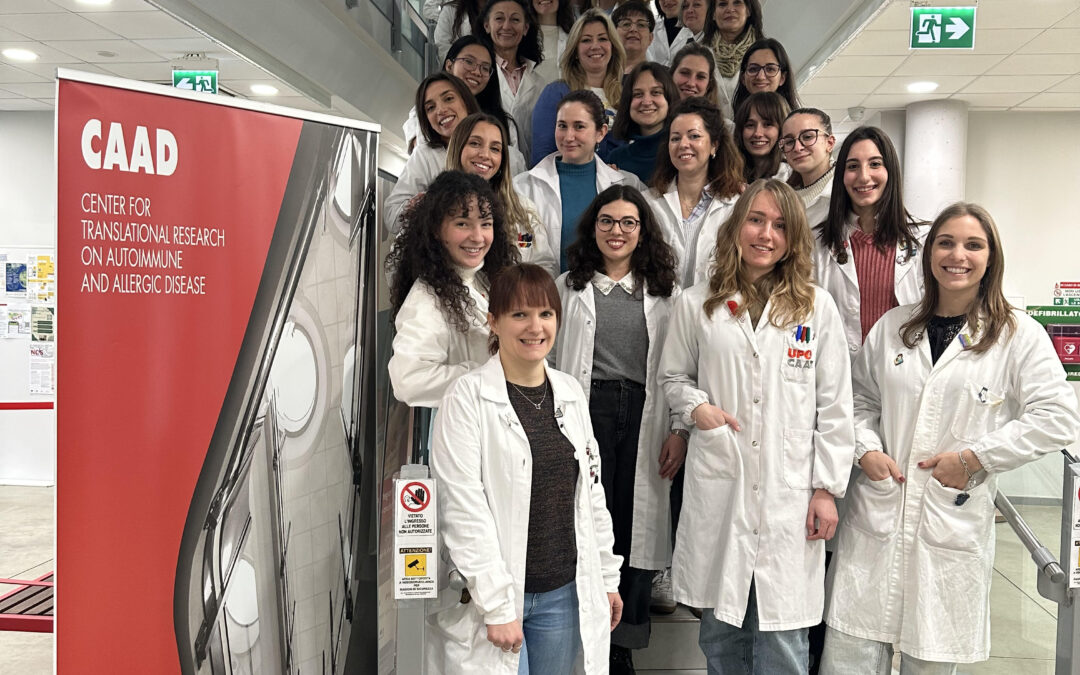
This day holds even greater significance this year, marking a decade of its celebration. In honor of this milestone, today, the women and girls at the Center for Translational Research on Autoimmune and Allergic Disease (CAAD) at UPO come together in solidarity, capturing a moment of unity, strength, and determination.
The name of CAAD is a tribute to the brilliant Ipazia (Hypatia), an extraordinary woman who, centuries ago, broke boundaries as a leader in philosophy and astronomy in Alexandria. Her legacy reminds us of the power of women in shaping intellectual progress. History is rich with the stories of countless women who, despite the odds, have made immeasurable contributions to science, carving paths for future generations to follow.
Among these trailblazers is Hildegard of Bingen, a visionary naturalist and healer; Ada Lovelace, the first computer programmer whose genius laid the foundation for modern computing; Marie Curie, whose relentless pursuit of discovery earned her not one, but two Nobel Prizes; Rosalind Franklin, whose work on the structure of DNA was pivotal to one of the greatest scientific breakthroughs of all time; and Margherita Hack, an astrophysicist whose passion for the stars propelled Italian astronomy into new frontiers.
These women, and so many more, have forever changed the course of science, defying the constraints of their time, and leaving an indelible mark on humanity’s collective knowledge.
The International Day of Women and Girls in Science is more than just a celebration; it is a poignant reminder of the profound impact women and girls have had, and continue to have, in shaping our world through science and technology. Yet, it also calls us to action, urging us to not only honor their achievements but to ensure that their voices are heard, their ideas celebrated, and their futures in science made limitless.